U.S. Territories Shipping Overview
Last updated: November 5, 2026
If you sell to customers in Puerto Rico, Guam or another U.S. territory, those orders ship as domestic mail with U.S. ZIP codes, but they don't behave like orders to the lower 48. Fewer carriers deliver there, delivery takes longer, and some destinations need customs information on the label. Here's what to expect and how we recommend setting your store up for them.
At a glance
Destination | Postal code | USPS zone | DHL eCommerce zone | Customs information needed (USPS and DHL) |
|---|---|---|---|---|
Puerto Rico | PR | Zone 8 | Zone 11 | No |
U.S. Virgin Islands | VI | Zone 8 | Zone 11 | No |
Guam | GU | Zone 8 | Zone 12 | Yes |
Northern Mariana Islands | MP | Zone 8 | Zone 12 | Yes |
American Samoa | AS | Zone 8 | Zone 12 | Yes |
Micronesia, Marshall Islands, Palau | FM, MH, PW | Zone 9 | Zone 12 | Yes |
USPS has a 10 day or more service expectation for Ground Advantage to every destination above, and DHL eCommerce doesn't commit to a delivery time for any of them. Priority Mail is faster; USPS shows an estimated delivery date for each ZIP code when the label is created.
Who does what
Manifest: ships each order with a carrier that delivers to the destination and transmits customs details on the label.
You: keep customs information complete on your products, and set up territory shipping rates and delivery estimates at checkout.
Your Account Manager: sets up a custom territory rate shop method on request and answers questions about routing or charges.
When to use this guide
You sell, or want to start selling, to customers in a U.S. territory or a freely associated state.
You're setting up shipping rates or delivery estimates for territory customers.
A territory order was delayed, returned for missing customs information, or cost more than you expected.
When not to use this guide
Situation | Use instead |
|---|---|
The order ships to Alaska or Hawaii | |
The order ships to an APO, FPO or DPO military address | |
The order ships to another country |
Before you start
Have your Manifest Rate Card open. You'll use the individual carrier tabs.
Know which of your products, if any, are hazardous materials, such as perfume, nail polish, aerosols, some essential oils or anything with a lithium battery.
1. What counts as a U.S. territory
A U.S. territory is land under U.S. sovereignty that isn't part of any state or the District of Columbia; the federal government calls these places "insular areas." Puerto Rico and the Northern Mariana Islands are commonwealths, meaning they have a written agreement with the U.S. that gives them more self-government. People born in the inhabited territories are U.S. citizens, except in American Samoa, where they're U.S. nationals.
Inhabited territories
Territory | Region | ZIP codes |
|---|---|---|
Puerto Rico (commonwealth) | Caribbean | 006xx, 007xx, 009xx |
U.S. Virgin Islands (St. Thomas, St. Croix, St. John) | Caribbean | 008xx |
Guam | Western Pacific | 96910 to 96932 |
Northern Mariana Islands (commonwealth; Saipan, Rota, Tinian) | Western Pacific | 96950 to 96952 |
American Samoa | South Pacific | 96799 |
Uninhabited territories
Nine small territories have no permanent residents: Navassa Island in the Caribbean, and Baker Island, Howland Island, Jarvis Island, Johnston Atoll, Kingman Reef, Midway Atoll, Palmyra Atoll and Wake Island in the Pacific. They have no residential mail delivery, so an order addressed to one is almost always an address error.
Freely associated states
The Federated States of Micronesia (ZIP codes 96941 to 96944), the Marshall Islands (96960, 96970) and Palau (96939, 96940) are independent countries, not territories. Under their Compact of Free Association with the U.S., USPS delivers to them as domestic mail, so they ship much like the Pacific territories.
What isn't a territory
Alaska and Hawaii are states, covered in Alaska and Hawaii Shipping Overview.
APO, FPO and DPO addresses (postal codes AA, AE and AP) are military and diplomatic mail, covered in Standard Shipping Rules We Apply to Your Orders.
2. Which carriers deliver
USPS delivers to every destination in this guide, and DHL eCommerce delivers with the limits in section 4. UniUni, GOFO, Veho, ShipX and UPS SurePost don't deliver to territories.
Other UPS and FedEx services vary. UPS has ground and air zones for Puerto Rico. FedEx Ground doesn't deliver to Puerto Rico. FedEx treats Puerto Rico and the territories as international destinations, and UPS lists the U.S. Virgin Islands in its international zones, so many UPS and FedEx shipments to territories go on international services that need customs paperwork. These options usually cost more than USPS or DHL, so talk to your Account Manager if you need one for a specific order.
PO Box addresses always ship with USPS under our standard shipping rules.
3. What you're charged
You're invoiced at the rate on your rate card's tab for the carrier and service that shipped the package, in the zone column for that destination (see At a glance).
On the DHL tabs, the territory zone price rises sharply once a package reaches 1 lb. DHL is usually the lower cost option under 1 lb, and USPS Ground Advantage is usually lower from 1 lb up.
Carrier surcharges aren't part of rate card pricing and are passed through on your invoice. See Manifest Invoices - Client Detail Excel File.
4. Customs information and product limits
Customs information
Guam, the Northern Mariana Islands, American Samoa and the freely associated states are outside U.S. customs territory, so packages to them need customs details:
USPS: a customs declaration on packages weighing 16 oz or more. Packages without one are returned.
DHL eCommerce: a description, quantity and value for every item on every package, or the label won't generate.
ShipHero adds the customs declaration to these labels automatically, so there's nothing to turn on. It builds the declaration from four fields on each product in ShipHero:
Field | What it's used for | If it's blank |
|---|---|---|
Customs Description | What the item is | The product name is used |
Customs Value | The declared value | The order line price is used |
Tariff Code | The HS code | The account's default tariff code is used |
Country of Manufacture | Where the item was made | The default country (US) is used |
Keep all four filled in. The fallbacks can produce a vague description or, for free and subscription items, a $0 value, either of which can get a package held or returned. The declaration is only added when the address uses the territory's two-letter postal code as the state, which Shopify does by default, and it isn't added to return labels.
Puerto Rico and the U.S. Virgin Islands don't need customs information for mail from the mainland. The one exception is a USPS shipment of goods worth more than $2,500, which needs an electronic export filing. Let your Account Manager know before an order that large ships.
DHL limits for territory ZIP codes
DHL SmartMail Parcel Ground and Parcel Expedited only; DHL SmartMail Expedited Max isn't available.
No dangerous goods.
No more than 5 items per package.
Declared value of $400 or less per package.
Orders outside these limits ship with USPS.
Hazardous materials
Most mail to the territories moves by air, so hazardous materials may be restricted or refused. Talk to your Account Manager before selling them to territory customers.
5. Our recommendations
A note on Shopify
Shopify lists the territories under United States as if they were states. When you add the United States to a market or shipping zone, all of them are selected by default, shown as 62 of 62 states (1), and the list includes territories such as American Samoa (2). If you leave them selected, territory customers see and pay your lower 48 shipping rates, even though the cost to ship there can be much higher.
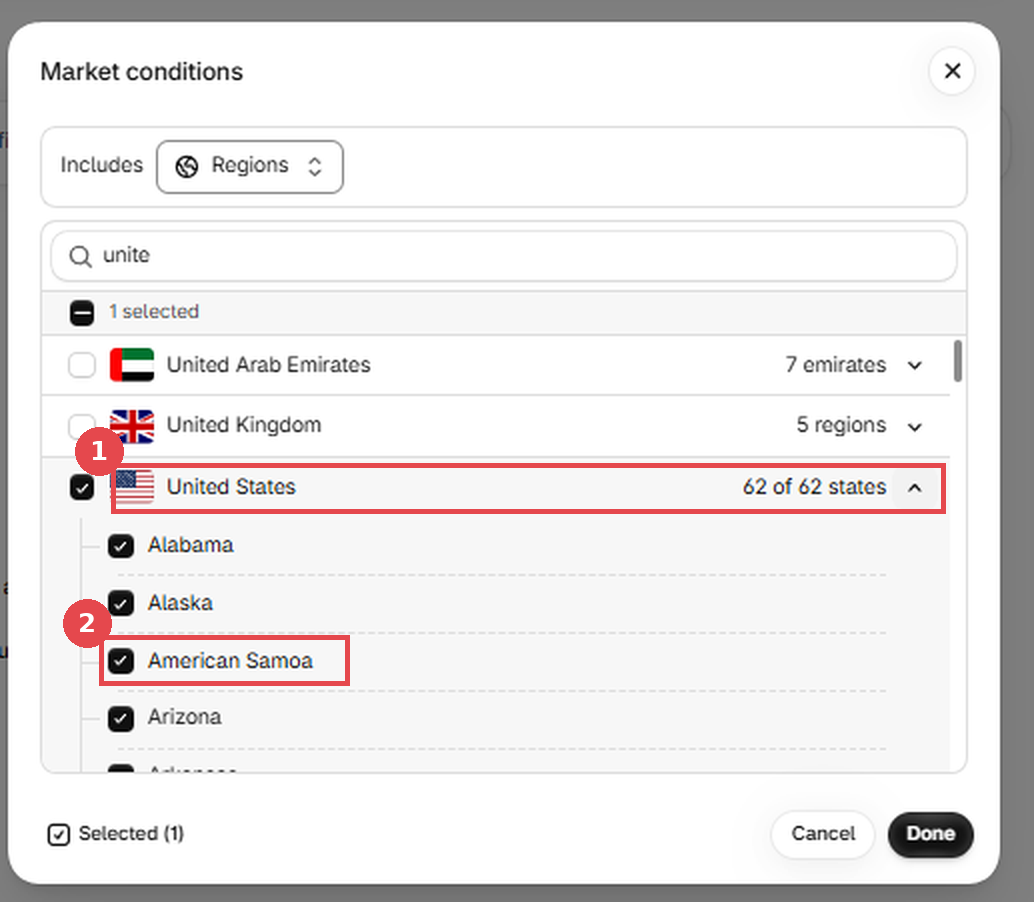
Expand United States and either uncheck the territories you don't want to ship to, or move them into a shipping zone of their own with territory rates.
Recommendations
Give territories their own shipping rates. A separate Shopify shipping zone lets you charge shipping that covers the higher cost and show a delivery estimate that matches reality.
Put the delivery time in the rate name. For example "Territories Economy (10+ days)" for USPS Ground Advantage.
Offer USPS Priority Mail as the faster option. It's the quickest widely available service to every territory.
Ask for a territory rate shop method. A custom method built for territories (DHL SmartMail under 1 lb where DHL's limits allow, USPS Ground Advantage otherwise) keeps these orders on the lowest cost service that delivers. Your Account Manager can set it up; see the Custom rate shop configurations section of How to Set Up and Configure Shipping Methods.
Keep customs data complete. Fill in Customs Description, Customs Value, Tariff Code and Country of Manufacture on every product you sell to territory customers, including free and subscription items. See International Shipping Setup & Guidance.
Collect a phone number at checkout. Carriers use it to reach the customer when a package is held.
Things to avoid
Don't leave territories turned on in your U.S. shipping zone by default. Customers there get lower 48 shipping prices on orders that cost much more to ship.
Don't map territory rates to a lower 48 budget rate shop method. Most of its carriers don't deliver to territories, so orders fall back to whatever service is left.
Don't estimate territory costs from the service class tabs. Tabs like 3-8+ Day Budget only cover zones 1 to 8 in the lower 48 and include carriers that don't deliver to territories.
Don't promise lower 48 delivery times. A "2-5 day" promise to a territory leads to late orders and customer complaints.
Don't rely on the customs fallbacks. A blank customs value on a free or subscription item goes out as $0, and a vague product name can get a package held or returned.
Related
External references
USPS Publication 28, Appendix B: Two-Letter State and Possession Abbreviations
USPS Domestic Mail Manual 608: Postal Information and Resources
USPS: Holiday Shipping Deadlines (offshore Ground Advantage service expectation)
FedEx Developer Guide: FedEx Ground Economy (U.S. territories as international destinations)
FedEx: Zone Locator (sample, shows Puerto Rico FedEx Ground as NA)